
Kyoto Autumn Foliage: Arashiyama, Tofukuji & Eikando
About Autumn Foliage in Kyoto
"When you think of autumn leaves, you think of Kyoto" — there is not the slightest exaggeration in those words. Autumn in the ancient capital wraps the mountainsides in blazing reds, oranges, and yellows, blending with the solemn presence of temples and shrines that have recorded a thousand years of history, creating scenery so breathtaking it leaves you speechless. A moment that takes your breath away waits with every step you take — that is autumn in Kyoto.
The best viewing period is typically late October to late November. Because the timing of the coloring differs by elevation and location, the autumn foliage front begins in the mountainous areas of the north and slowly moves south toward the city center. Planning your trip while chasing that gradual shift is one of the joys unique to autumn in Kyoto. During this season Kyoto draws travelers from both within Japan and abroad, making it the busiest time of the entire year. That is precisely why gathering information and planning in advance greatly affects the quality of your trip. With this guide in hand, savor the autumn of the ancient capital to the fullest.
Arashiyama
Autumn foliage reflected on the water, wind passing through the bamboo grove, and vermilion-lacquered railings — autumn in Arashiyama brings a dreamlike sensation, as if you have wandered into a single Japanese painting. The sight of colorful trees reflected on the calm surface of the Oi River (Katsura River) is Kyoto's foremost autumn scenery, stirring something deep within your chest no matter how many times you visit.
What you absolutely must not miss is the Arashiyama mountainside viewed from Togetsukyo Bridge. Stand on the bridge and turn your gaze upstream, and a panorama of slopes dyed entirely in red and gold spreads out endlessly. The scale is far too vast for a smartphone camera to capture, and you will surely find yourself standing still in awe. Walk a little further into the garden of Tenryuji Temple, and you can enjoy the contrast between the autumn leaves reflected in Sogen Pond and the white sand, with a world straight out of a postcard unfolding before your eyes. Sitting at the edge of the pond and quietly watching the foliage sway on the water is a luxury that nothing else on the trip can replace.
Best Season and Recommended Times The best viewing period is mid to late November. To avoid the crowds, a visit before 8 a.m. is absolutely recommended. Standing on Togetsukyo Bridge with few people around, the stillness of the river surface and the vividness of the foliage seem to seep into all five senses, offering a serene face entirely different from the daytime. In the early morning the light filters softly through the bamboo path as well, and the green together with accents of autumn color takes on a fantastical atmosphere. Dusk is also recommended; the twilight hour when the madder-red sky overlaps with the foliage on the mountainside is breathtakingly beautiful.
Local-Style Enjoyment and Hidden Spots Most tourists turn back around the area of Togetsukyo Bridge, but Jojakkoji Temple and Nisonin Temple, a little to the north, are among Arashiyama's finest foliage spots while still allowing relatively relaxed viewing — hidden gems beloved by local connoisseurs. In particular, the combination of Jojakkoji's stone steps and blazing autumn leaves is so stunning your hands won't stop reaching for the camera. When you turn around partway up the steps, a sea of foliage spreading below makes you let out an involuntary gasp. Also, the Hozugawa River Boat Ride, where you can take in the gorge's foliage with your whole body while rocking in a small boat, is one of the luxurious pastimes long cherished by those who know the area. The red of the mountainside seen from the river has an impact entirely different from viewing it on land.
Access
- By Train (Recommended): About a 10-minute walk from JR Sagano Line "Saga-Arashiyama Station," or about a 5-minute walk from Hankyu Arashiyama Line "Arashiyama Station"
- Randen (Keifuku Electric Railroad): Get off at "Arashiyama Station" from Shijo-Omiya or Katabiranotsuji. The retro scenery from the windows is full of travel charm, making the ride itself a pleasure
- Approximate time from Kyoto Station: About 25-30 minutes by train
During the foliage season the roads around Arashiyama become severely congested, so visiting by car or taxi is strongly discouraged. Wisely using public transportation is the basic premise for fully enjoying Arashiyama. On weekends there may even be waits to board the Randen, so allow plenty of time in your plans.
Tofukuji Temple
Tofukuji, called "Kyoto's largest-scale autumn foliage," sees its entire grounds covered in a blazing red carpet every November. Its overwhelming scale never fails to astonish — no, to rob of words — first-time visitors; that is how powerful it is. Here, the experience of "having seen autumn leaves" turns into the sensation of "having been swallowed by them."
The greatest highlight is the foliage of Sengyokukan viewed down from Tsutenkyo Bridge. The experience of looking down from the bridge upon a sea of maples filling the deep ravine offers a level of emotion in a class of its own even among Kyoto's foliage spots. As far as the eye can see, red, red, red — that flood of color is on an entirely different dimension when seen in person versus in a photo. Even after crossing the bridge, the scene refuses to fade from your mind. The contrast between the checkerboard moss of the Hojo Garden (National Historic Site and Place of Scenic Beauty) and the autumn leaves is also magnificent; the unique beauty where modern Zen aesthetics meet autumn's colors is scenery found nowhere else but Tofukuji.
Best Season and Recommended Times The best viewing period is mid to late November. Tofukuji is also known as one of Kyoto's most crowded spots; especially during weekend daytimes Tsutenkyo Bridge fills with people, making it difficult even to stop and stand still. Aiming for right after opening on a weekday (in the 8 a.m. hour) is the very best of the best. The foliage of the ravine lit by the soft morning light shines all the more vividly in the crowd-free quiet. The time just before closing is also relatively empty, and aiming for the moment when the slanting evening light dyes the foliage golden is recommended too. Note that there is no nighttime illumination, so a daytime visit is the standard.
Local-Style Enjoyment and Hidden Spots Touring the sub-temples (small temples within the grounds) scattered across Tofukuji's precincts is a longtime standard among local foliage connoisseurs. Among them, Sojuin and Taikoan hold special autumn openings during certain periods, allowing for quiet foliage viewing entirely unlike the main area bustling with tourists. Time spent gazing alone and quietly at leaves falling unseen — such a luxury is the true delight of touring the sub-temples. Also, the combination of the stone pavement of the approach leading to Tofukuji and the foliage on both sides is beloved by local photographers as a hidden, photogenic shooting spot. The foliage journey has already begun before you even enter the grounds.
Access
- By Train (Recommended): About a 10-minute walk from "Tofukuji Station" on the JR Nara Line or Keihan Main Line
- Approximate time from Kyoto Station: An overwhelmingly excellent location of just about 3 minutes by JR. It boasts some of the best access in all of Kyoto sightseeing
- By Bus: Get off at the "Tofukuji" city bus stop, then about a 10-minute walk. However, buses during foliage season tend to be delayed, so prioritize using the JR
During the foliage season the on-site parking lots are closed (from October 25 to December 10, Tofukuji closes its grounds to general vehicle access), and congestion on the surrounding roads is serious. Make the most of the superb location of just a few minutes by train from Kyoto Station, and a visit by public transportation is strongly recommended. The iron rule for conquering Tofukuji is to head there first thing in the morning rather than putting it off thinking "it's close, so later is fine."
Eikando Temple
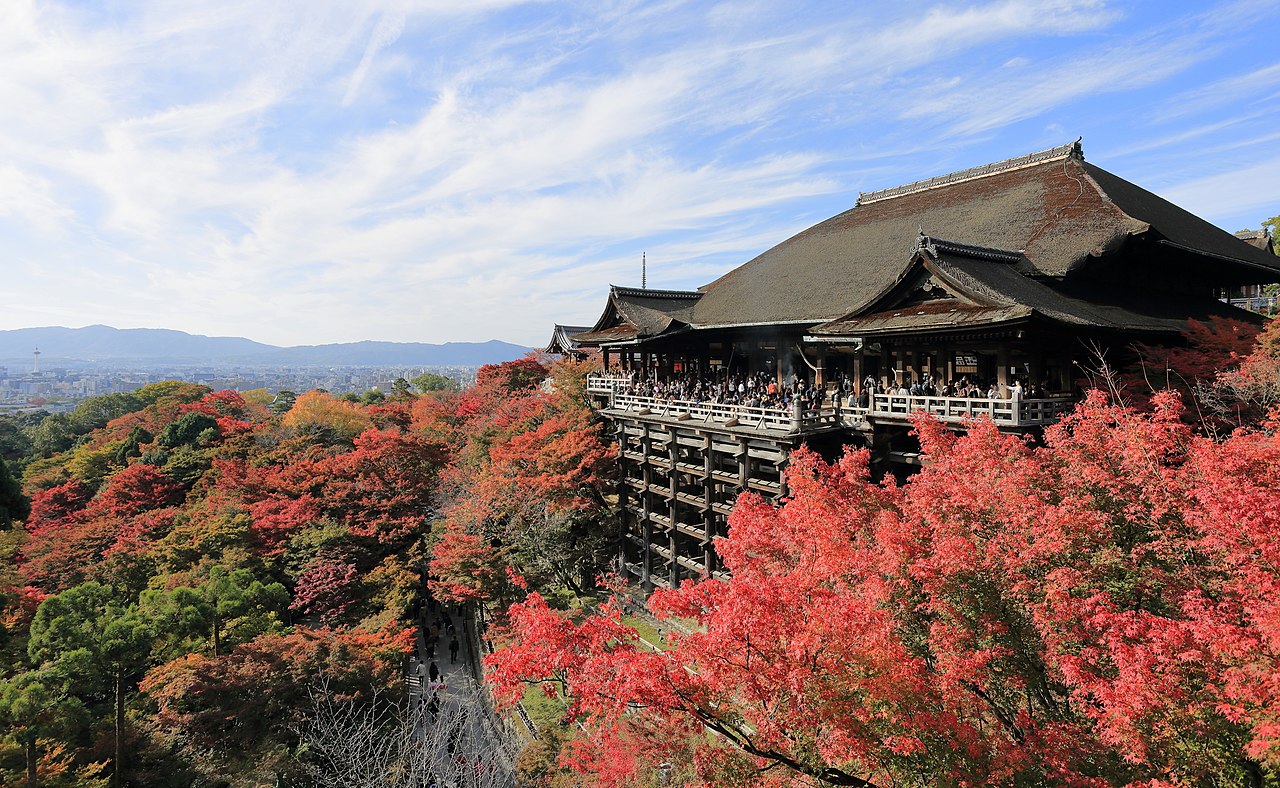
"Eikando of the maples" — it is called this because it is so deeply connected with autumn foliage. About 3,000 maple trees are planted within the grounds, and in autumn everywhere is dyed red, from the mountain slope to the garden and even at your feet along the corridors. Here there is a moist, gentle beauty of autumn foliage that draws close to the human heart, different again from Tofukuji's overwhelming scale and Arashiyama's painterly scenery. To the traveler who thinks "I want to savor the autumn leaves slowly, to my heart's content" — this is a spot I sincerely want you to visit.
The highlights are endless. The water mirror of Hojoike Pond, where the foliage seems to dissolve directly into the surface of the water, creates a fantastical scene on windless days as if heaven and earth have been reversed. The gradation of the garden seen while walking the corridors, and the grand panorama of the Kyoto cityscape and foliage seen from around the Tahoto pagoda, are the climactic showpieces of the grounds. Furthermore, because the grounds have a complex structure that skillfully makes use of the mountain slope, your viewpoint changes with every step you take, letting you encounter foliage with a different expression each time. The sense of anticipation — "what could be further ahead?" — continues without break; this succession of discoveries is Eikando's true forte.
Best Season and Recommended Times The best viewing period is mid to late November. The special nighttime viewing (illumination) held annually to match this period can be called the greatest highlight of Eikando's foliage viewing. The foliage illuminated by gentle light gives off a bewitching, fantastical beauty entirely different from its daytime vividness, standing out all the more in the silence of night. It is especially highly rated even among Kyoto's foliage illuminations, and experiencing it once will surely become an unforgettable evening. The dates and hours change from year to year, so be sure to check the latest information on the official website before visiting. For daytime viewing as well, the early morning hours allow for relatively calm appreciation and are recommended.
Local-Style Enjoyment and Hidden Spots A combined visit with nearby Nanzenji Temple is a standard course for local connoisseurs. The foliage seen from atop Nanzenji's Sanmon gate is, in a word, spectacular, and furthermore, the scene where the Suirokaku (brick-built arched aqueduct) within the grounds overlaps with the foliage has become a popular shooting spot as picturesque scenery that is neither quite Japanese nor Western. The route walking from Eikando to Nanzenji is a rich course that can be fully enjoyed in half a day. Also, since Eikando is close to the southern end of the "Philosopher's Path," a culturally rich day course walking north along the riverside path all the way to Ginkakuji is also recommended. The more you walk, the more Kyoto's depth settles into your body — such luxurious time can be enjoyed here.
Access
- By Bus: About a 3-minute walk from the "Nanzenji / Eikandomichi" city bus stop. This is the most standard means of access
- Subway + Walk: About a 15-minute walk from "Keage Station" on the Tozai subway line. The leisurely walking route passing by Nanzenji has picturesque scenery all along the way, making the stroll itself part of the trip
- Approximate time from Kyoto Station: About 30-40 minutes by bus (varies with congestion)
Buses during the foliage season are extremely crowded and prone to major delays, so a schedule with plenty of time to spare is what matters most. Using the subway's Keage Station makes timing easy to predict, and the route walking from Nanzenji to Eikando is full of travel charm. "Not hurrying" may be the secret to enjoying Eikando to the fullest.
Best Viewing Period and How to Enjoy the Foliage
Kyoto's autumn foliage is typically best from late October to late November. However, it often shifts by one or two weeks depending on the year, and to avoid the disappointing situation of "it was still green when I went" or "it had already finished falling," we recommend always checking the latest foliage conditions on the official information from the Kyoto City Tourism Association and each temple and shrine before your trip. The more effort you put into gathering information, the more certainly your trip's satisfaction will rise.
Tips for Travelers
- 🕐 Early morning is the golden time: At any spot, if you can arrive by the 8 a.m. hour, you can enjoy quiet foliage before the crowds. Rising early is worth not just a small reward but tens of thousands of yen in value
- 🚌 Public transportation is the iron rule for getting around: During foliage season the entire city falls into chronic congestion. Wisely combine train, bus, and walking, and keep in mind that "walking" is a fine means of transportation too
- 👟 Comfortable walking shoes are a must: Stone pavements, steep slopes, and long approaches continue. Heels and leather shoes are strictly forbidden. Visit in sneakers or other shoes well broken in to your feet
- 📷 Charge your camera and free up storage to the max: You will want to take more photos of Kyoto's foliage than you imagine. Bringing a spare mobile battery and memory card just in case provides peace of mind
- 🧥 Adjust your body temperature with layers: November Kyoto can be chilly even during the day, and temperatures drop especially in the morning and evening. Tucking a light coat or stole into your bag keeps you comfortable even during long outdoor viewing
- 🗓 Be prepared for considerable crowds on weekends and holidays: If possible, a weekday visit is best. If that's difficult, simply "rising early" is the strongest and only countermeasure. The peak of the crowds is from 10 a.m. to 3 p.m. Just wisely avoiding this time band completely changes the quality of the experience
Arashiyama, Tofukuji, and Eikando each have their own distinct charm. Overwhelmed by scale, soothed by stillness, and captivated by the changing light — the foliage you encounter at each spot will surely be carved deeply and vividly into your memory. Now, off to the ancient capital dyed in autumn colors —.
Practical Information for the Autumn Foliage Season (Based on Official Announcements)
Arashiyama: In Late November, "The Southbound Bus Stops Disappear"
The City of Kyoto (Walking City Kyoto Promotion Office) implements large-scale traffic controls in the heart of Arashiyama during the peak foliage period. The arrangements for 2025 were as follows.
| Section | Dates | Restriction |
|---|---|---|
| Nannenzaka-dori (Sanjo-dori – Marutamachi-dori) | 22, 23, 24, 29, 30 November | 10:00–13:00 northbound one-way / 13:00–17:00 pedestrian-only road (all vehicles including light vehicles prohibited) |
| Sagakaidori (north end of Togetsukyo Bridge – in front of Hankyu Arashiyama Station) | 22, 23, 24, 29, 30 November | 10:00–17:00 southbound one-way (except scheduled buses and light vehicles) |
| Nannenzaka-dori | Weekdays 17–28 November | 10:00–17:00 northbound one-way |
The same framework was used in autumn 2018, so it is safe to plan around restrictions applying on weekends and public holidays in late November and the weekdays around them. Note also that Nannenzaka-dori operates as northbound one-way on weekends and public holidays from 10:00–17:00 throughout the year.
The most practical headache this causes is that southbound bus stops such as "Nonomiya" and "Tenryuji-mae" become unavailable. You may be able to arrive by bus, but you cannot go back the same way. Plan your return journey using the Randen (Keifuku Electric Railroad) or JR Sagaarashiyama Station.
On restriction days, the Arashiyama Hoshokai runs a shuttle taxi (circulating between JR Sagaarashiyama Station and Randen Arashiyama Station; in 2025 this ran from 17 to 28 November), though fares and frequency have not been published.
Car parks: The Kyoto City Arashiyama Sightseeing Car Park has 105 spaces for ordinary cars, operates 8:00–17:00, and charges 1,040 yen per entry (Kyoto City Urban Improvement Corporation). However, the Corporation explicitly states: "As we give priority to buses and taxis, we may refuse entry to private vehicles during busy periods and times of expected congestion." Do not plan on arriving by private car during the foliage season. Tenryu-ji's car park has 100 spaces at 1,000 yen per car, open 8:30–17:00.
Tenryu-ji is open 8:30–17:00 (last entry 16:50), with garden admission at 500 yen (300 yen for primary and junior high school students) and additional buildings at +300 yen. In 2026, a special early-morning opening at 7:30 is planned for 14–30 November. If you want the Sogenchi Pond Garden with minimal crowds, this is your best opportunity.
On Arashiyama after dark: The "Arashiyama Hanatouro" illumination event ended after its 2021 edition (December 2021). The reliable autumn-and-winter night lighting currently in the Arashiyama area is the Sagano Scenic Railway's "Hikari no Gensou Ressha" (Fantasy of Light Train) (in 2025: illuminated from 25 October to 29 December, applicable to trains departing Torokko Kameoka from 16:30 onwards). Tickets go on sale on the official website from midnight one month before the travel date; advance sales at station windows are not available.
Tofuku-ji: The Car Park Is "Closed" During the Foliage Season
Tofuku-ji closes its general car park to private vehicles from 25 October to 10 December. The official website advises: "Coin-operated car parks in the neighbourhood are also limited, so please use public transport to visit." This is not merely a recommendation to take the train because it is busy — you simply cannot park there.
Motorcycles (including scooters) may use the Niomon Plaza and the Nakamon car park, and bicycle parking is available near the Rokuhara-mon Gate.
Furthermore, in 2025, on 22, 23, 24, 29, and 30 November from 9:00 to 16:00, the access road to Tofuku-ji was closed to vehicles, Honmachi-dori was subject to a temporary traffic restriction, and the road on the north side of the Kujo Overpass was made westbound one-way.
| Visiting Hours | Admission | |
|---|---|---|
| Normal period | 9:00–16:00 (last entry 16:00, gates close 16:30) | Main precinct garden 500 yen / Tsutenkyo Bridge & Kaisando 600 yen / Combined ticket 1,000 yen |
| Autumn period (14 Nov – 6 Dec) | Tsutenkyo from 8:30 / Hojo garden from 9:00 (last entry 16:00) | Main precinct garden 600 yen / Tsutenkyo Bridge & Kaisando 1,000 yen (children 500 yen) / No combined ticket |
During the autumn period no combined ticket is sold, so seeing both areas costs 1,600 yen in total. This is something worth knowing before you arrive to avoid confusion at the gate.
Food and drink are not permitted on the grounds; tripods are prohibited. Photography at Tsutenkyo Bridge and Gaunbashi Bridge may be restricted during the special autumn opening period.
Evening admission is by complete advance reservation only — no walk-up tickets are available. In 2025 it ran from 19 November to 7 December, 17:30–19:30 (last entry 19:00), with a capacity of 1,020 visitors per evening via JR Tokai's "EX Travel Reservation" electronic ticket system (a smartphone is essential). The early-morning reserved session in 2025 ran from 20 November to 8 December, 7:30–8:30, with 510 places per day. The booking channel varies from year to year, so always check that year's official announcement.
Eikan-do: Day and Evening Visits Use a Strict "Change-Over" System
The planned schedule for 2026 is: the Autumn Temple Treasure Exhibition from 11 November to 6 December (reception 9:00–16:00, closing at 17:00) at 1,500 yen for adults, 1,000 yen for university and vocational school students, and 800 yen for junior and senior high school students. The illumination runs from 20 November to 6 December (reception 17:30–20:30, closing at 21:00) at 1,000 yen for junior high school students and above.
The crucial point here is this official caveat:
The Autumn Treasure Exhibition and the illumination operate on a change-over basis; continuous viewing is not possible.
This means you cannot stay on from the daytime session into the evening. If you want to see both, you must exit and re-enter, paying a combined total of 2,500 yen. Note that the evening session is priced at "1,000 yen for junior high school students and above" only; the temple's official information contains no statement about the treatment of primary school children.
During the Autumn Treasure Exhibition period, "private cars and tour buses (excluding minibuses) are not permitted to enter," meaning the temple car park is effectively unavailable. The official website directs visitors to the Okazaki Park car park instead.
When Is Peak Colour?
Kyoto City's official "Kyoto Tourism Navi Autumn Leaves Report" gives the peak period for Arashiyama, Tofuku-ji, and Eikan-do as mid- to late November across the board. The same site states that information is "published based on responses from individual temples, shrines, and facilities," making it the most reliable benchmark for peak timing.
For reference, the Kyoto Local Meteorological Observatory's official "maple reddening day" falls on 5 December on average, was 20 December in 2024 (the latest on record), and 10 December in 2025. This is a meteorological observation value with a different definition from tourist peak colour, and it points to a later date. Even if you hear in the news that "Kyoto's autumn leaves are in December," the peak at temples and shrines is in November.
Checklist Before You Go
- [ ] No cars at Tofuku-ji — the car park is closed (25 Oct – 10 Dec). Motorcycles and bicycles are fine.
- [ ] Return from Arashiyama via Randen or JR. Southbound bus stops are unavailable during parts of mid- to late November.
- [ ] If you want to see Eikan-do by day and night, the change-over system means you must exit and re-enter — total cost 2,500 yen.
- [ ] During the autumn period at Tofuku-ji, no combined ticket is sold (Tsutenkyo Bridge 1,000 yen + Main precinct garden 600 yen).
- [ ] Tenryu-ji: a special early-morning opening at 7:30 is planned for 14–30 November 2026.
- [ ] Evening admission at Tofuku-ji requires advance reservation. Walk-ins on the day are not admitted.
Information Sources
Kyoto City Walking City Kyoto Promotion Office / Kyoto City Tourism Association · Kyoto Tourism Navi / Tofuku-ji official website / Eikan-do Zenrin-ji official website / Tenryu-ji official website / Kyoto City Urban Improvement Corporation / Sagano Scenic Railway official website / Japan Meteorological Agency, Kyoto Local Meteorological Observatory
*Dates and prices are subject to change. Please check the latest information on each official website before you set out.*
📍 Location & Access


Share this article




✍️ About this article
This article is compiled by the Tabitabi JAPAN editorial team from official and primary sources, including facility and shrine/temple websites, tourism information published by municipalities and tourism associations, and cultural-property records released by national and local governments. Prices, opening hours and event dates may change, so please also check the official information of each facility or local government before you visit.