
Oita Local Gourmet Guide: Toriten (Chicken Tempura)
Toriten
If you visit Oita, the very first thing I want you to taste is "toriten." It may sound like a simple dish of making chicken into tempura, but the moment you take a bite, you will surely open your eyes wide at its depth. The batter is crisp and light yet has a firm bite, and the chicken inside is juicy and plump. Eating it dipped in vinegar-soy sauce or ponzu is the Oita way. The somehow refreshing aftertaste despite being fried keeps your chopsticks moving, "one more bite, one more bite." With the very first bite, you too will surely become captivated by this dish.
Characteristics
Oita's toriten uses thigh or breast meat, marinated firmly with ginger, garlic, soy sauce, and the like before frying—that is the local style. The difference from karaage is wrapping it in tempura batter. This thin batter locks the meat's umami tightly inside, creating the exquisite texture of crispy outside and juicy inside. The deliciousness of the moment when meat juices overflow with each bite is unforgettable once experienced. From long-established eateries in Oita City to casual family restaurants, the fact that it appears on the menu as a matter of course everywhere as a "prefectural dish" speaks to this dish's overwhelming popularity. For the people of Oita, toriten is not a feast for special days but an "ordinary deliciousness" that naturally exists on the daily table.
Best season / recommended time of day Toriten is a versatile dish you can enjoy year-round, but the combination with chilled beer is the best especially in summer. The contrast of the freshly fried heat and the refreshing vinegar-soy sauce is one reason it goes down smoothly even in the hot season. The recommended time is right before the dinner time of 5–7 p.m. in the evening. This time slot is relatively empty, letting you leisurely savor the piping-hot, freshly fried dish. Conversely, during the lunch peak (12:00–1:30 p.m.), it is not unusual for lines to form at popular shops, so if you are short on time it is wise to avoid it.
How locals enjoy it / hidden-gem info Stylish restaurants aimed at tourists are not bad, but if you want to encounter real toriten, head to the old-fashioned eateries dotted around Oita City's "Chuo-machi / Funai-machi area." Plain-looking shops that local men and women frequent daily are proof of preserving a taste unchanged for decades. A plate eaten while feeling the sound and aroma of frying across the counter is sure to be firmly etched into your travel memories. If asked when ordering, "Vinegar-soy sauce or ponzu, which would you like?", by all means order both and compare. You will surely be surprised by the depth of toriten that shows entirely different expressions in each.
Access Exit JR Oita Station and head north along Chuo-dori, and you will reach the area where famous shops are concentrated within a 10–15-minute walk. Rental bicycles are also available near the station, and using a bicycle lets you tour an even wider range efficiently and pleasantly. On a fine day, try enjoying a leisurely gourmet stroll by bicycle.
Tips for travelers Since popular shops often sell out or fill up at lunchtime, aiming for right after opening at 11:30 a.m. is best. The chances of eating freshly fried food without lining up go way up. Many shops also handle takeout, so enjoying it in a food-walking style is an Oita-like travel pleasure. However, since freshly fried is the most delicious, in the case of takeout it is recommended to eat it on the spot as much as possible.
Ryukyu
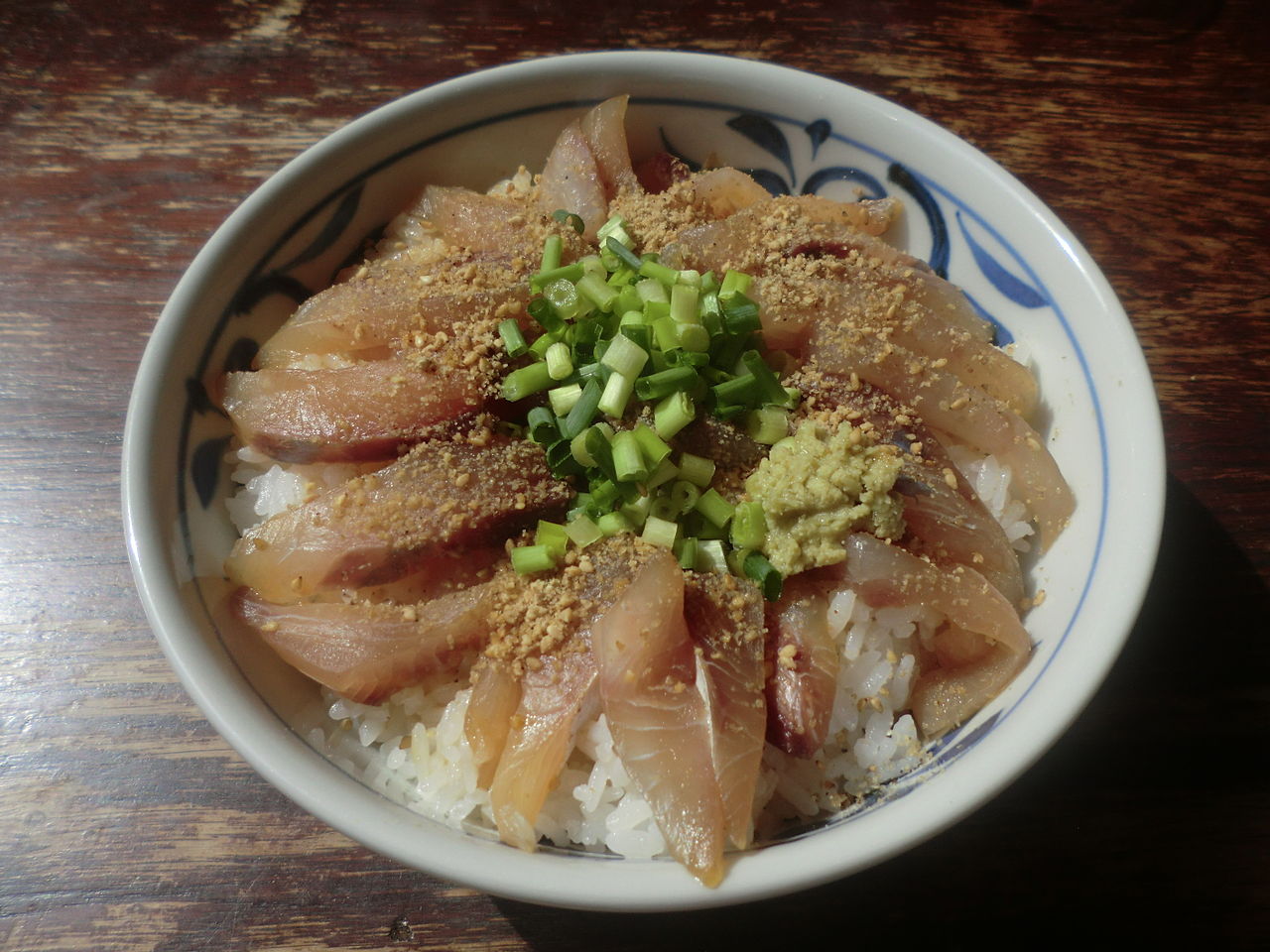
Hearing the name "ryukyu," some may have pictured Okinawan cuisine. But Oita's ryukyu is Oita's own proud local dish, in which fresh fish fillets are marinated generously in a sesame- and soy-sauce-based sauce. The springy, chewy texture of the fish and the rich sauce infused with the fragrance of sesame intertwine, and the compatibility with white rice is truly invincible. Take one bite and its complex, addictive taste clings to your memory forever and never leaves. There is also a theory that it was born so fishermen could eat fish just landed on the boat right away, and the richness of Oita's sea and the wisdom of the fishermen are condensed in a single plate.
Tips for food-walking
The real pleasure of ryukyu is, above all, in its "freshness." At Oita's fish markets and seafood eateries, many places offer ryukyu using horse mackerel, yellowtail, mackerel, and so on landed that very morning, and visiting around 7–9 a.m. lets you enjoy it as breakfast mixed in with local fishermen and market workers. Not a "breakfast experience" staged for tourists, but a real Oita morning where the scent of daily life drifts—this is an experience beyond anything else for a traveler.
Also, ryukyu is not only eaten as is; arrangements such as putting it over rice to make a "ryukyu bowl," or pouring hot tea or dashi broth over it to make "ryukyu chazuke," are the very standard locally. Just adding a word when ordering at an eatery, "Can you make it chazuke too?", greatly broadens your travel food experience. The gentle taste of chazuke with the sauce dissolved in glides smoothly even into a morning stomach—it is exquisite.
Best season / recommended time of day That the season changes depending on the fish used in ryukyu is also one of the pleasures. Early summer (May–July), when horse mackerel is plump, makes the refreshing sweetness of the fat stand out, while winter (November–February), when yellowtail wears plenty of fat, lets you enjoy a rich, melting mouthfeel. Both seasons have their own umami, and honestly it is hard to pick one over the other. By all means savor ryukyu made with the seasonal fish of when you visit, right there on the spot. As for time of day, the 6–9 a.m. hours when the market comes alive are by far recommended. It is the golden time to encounter ryukyu in its freshest state.
How locals enjoy it / hidden-gem info As a hidden gem not yet widely known to tourists, the "Sano Market" in Oita City and the morning markets in the Usuki and Saiki areas are recommended. Local mothers sometimes line up freshly made ryukyu, and you can encounter a real, unadorned, simple taste that has not been turned into a tourist attraction. At the small eateries inside the markets, you can sometimes enjoy a hearty set meal of ryukyu and local fish for close to a single coin. The experience of eating breakfast shoulder to shoulder with locals in a quiet market with hardly any travelers is sure to become a treasure of your trip.
Access The seafood markets in Oita City are conveniently located about 10–15 minutes by bus from JR Oita Station. The Usuki and Saiki areas are about 30–50 minutes from Oita Station by the JR limited express Nichirin, a distance fully enjoyable even on a day trip. If you want to tour multiple markets across areas, using a rental car gives you more freedom.
Tips for travelers Since it is a dish using raw fish, freshness management requires special care in summer. If you take it out, try to eat it as soon as possible. For those who want to take it home as an Oita souvenir, vacuum-packed ryukyu is convenient. Keeping it refrigerated lets you carry it home, and you can enjoy the afterglow of your trip once more. If you spot it at a market or roadside station, by all means pick it up.
Dango-jiru
Pushing through the curtain into an Oita eatery on a cold day, and an earthenware pot steaming profusely is carried before you—the feeling of happiness in that moment is almost impossible to express in words. Oita's representative local dish "dango-jiru" is a blissful bowl that warms you from the core of your body, with wide, flat wheat-dough strips (dango) torn by hand and dropped into a miso-flavored soup simmered slowly. The chewy, elastic dango clings moistly to the rich miso soup, and its deep flavor, infused with the umami of burdock, konjac, and seasonal vegetables, is "mom's taste" itself. As you eat, a nostalgia and warmth, as if from somewhere in distant memory, spread gently and warmly across your chest. For the people of Oita, dango-jiru is not a feast for special days but something that naturally lines the daily table. Into that ordinary everyday, we travelers are quietly allowed to intrude.
To wrap up your trip, by all means also check out souvenirs related to dango-jiru. Limited items you can get only within Oita Prefecture, such as dango-jiru dried-noodle sets and special miso, line the shelves at roadside stations and airport shops. Even when you try to recreate it after returning home, somehow it cannot match that taste you ate while traveling—such a bittersweet yet sweet feeling may also be a real pleasure of travel.
Best season / recommended time of day When dango-jiru shines most is from autumn to winter (October–March). The contrast of the cold outside air and the heat of the earthenware pot amplifies the emotion of each bite many times over. Visiting a home-style cooking eatery at dinner time (6–8 p.m.) raises the chance of encountering an authentic bowl using handmade dango kneaded since that morning. An eatery lighting up at the end of a dim dusk alley you have walked down—dango-jiru eaten in such a situation is exceptional.
How locals enjoy it / hidden-gem info If you want to experience the home of dango-jiru, I strongly recommend extending your trip to the mountainous Yufuin, Taketa, and Kokonoe areas rather than within Oita City. At farm restaurants and roadside stations, many places offer "authentic dango-jiru" using vegetables grown in that land abundantly, and you can encounter a simple, robust taste that has not been turned into a tourist attraction. After taking a bath at Yufuin Onsen to loosen up your body, slowly slurping dango-jiru at a small local eatery—is there any greater travel happiness than this? A supremely luxurious time, where the afterglow of the hot spring and the warmth of dango-jiru overlap, awaits you.
Access To the Yufuin area, about 1 hour 10 minutes from JR Oita Station on the popular sightseeing train "limited express Yufuin no Mori." The journey, enjoying the mountain scenery changing from the train window, is also part of the trip. To Taketa City, about 1 hour on the JR Hohi Main Line. To the Kokonoe area, about 1 hour by car using the expressway from Oita Station is the guide, and you can access it while driving through vast nature.
Tips for travelers Many shops make dango-jiru by tearing the dough only after receiving the order, so it can take about 15–20 minutes until served. If you are in a hurry, confirming in advance is reassuring. Also, the volume is quite large, enough that one bowl satisfies your stomach firmly. If combining with other dishes, asking whether you can order a small portion helps prevent overeating. Wrapping up your trip with a single bowl of dango-jiru as the final dinner is also a wonderful choice as an Oita-like travel finale.
Access / Business Hours
The base for a journey touring Oita Prefecture's local gourmet is, after all, JR Oita Station. Making this station, where access from all directions—Shinkansen, limited express, highway bus—gathers, your starting point lets you tour the famous shops of toriten, ryukyu, and dango-jiru efficiently and without waste.
- Oita City area: Accessible within 10–15 minutes on foot or by bus from JR Oita Station. There are also rental bicycles near the station, and bicycle travel is the most comfortable for a gourmet stroll.
- Yufuin area: About 1 hour 10 minutes by limited express from JR Oita Station. A standard Oita-trip course where you can enjoy hot springs and gourmet together.
- Saiki / Usuki area: About 30–50 minutes by limited express from JR Oita Station. An area not to be missed for ryukyu lovers, with fresh seafood on offer.
- Kokonoe / Taketa area: A rental car is the most convenient. About 1–1.5 hours by car from Oita Station. The experience of having dango-jiru amid magnificent nature becomes a lifelong memory.
Business hours of each shop vary, but lunchtime (11 a.m.–2 p.m.) and dinnertime (5–9 p.m.) are the general guide. Morning markets and market types are mainly 6–9 a.m. In any case, be sure to confirm the latest information on each shop's official social media or by phone before visiting. A bit of advance effort, so you do not strike out due to a regular holiday or temporary closure, greatly affects the satisfaction of your trip.
At Oita Prefecture's tourist information centers (inside JR Oita Station and in front of Yufuin Station), the staff will kindly tell you that day's recommended shops and crowding information. By all means stop by at the start of your trip. The tourist-information staff are often local gourmets themselves, and you may be quietly told of hidden famous shops that appear neither on maps nor on review sites. Such chance encounters and information are sure to make your trip many times richer. Oita's gourmet may be something to savor not only at the moment of eating, but including the way you encounter it.
Practical Information for Your Visit
- Public facility where you can taste it: The Oita City Municipal Wholesale Market (3-2-1 Toyomi, Oita City, and 4-1-1 Toyomi, Oita City / TEL 097-533-3113). It has a fruit and vegetable section and a marine products section, as well as an area of associated shops
- Points to note (food safety): Ryukyu is a dish made with raw fish. If you take it away with you, keep it cool and eat it as soon as possible
*Opening hours and closing days of the market's associated shops and of individual shops vary from shop to shop. Always check before visiting.
(Sources: the Oita City official website (Municipal Wholesale Market, Department of Agriculture, Forestry and Fisheries))
📍 Location & Access




Share this article


✍️ About this article
This article is compiled by the Tabitabi JAPAN editorial team from official and primary sources, including facility and shrine/temple websites, tourism information published by municipalities and tourism associations, and cultural-property records released by national and local governments. Prices, opening hours and event dates may change, so please also check the official information of each facility or local government before you visit.