Kunisaki Peninsula: Exploring the Buddhist Temple Complex of Rokugo Manzan
The Kunisaki Peninsula, jutting out roundly into the northeastern part of Oita Prefecture, is a sacred zone where the distinctive mountain Buddhist culture Rokugo Manzan, continuing since the Nara period, still vividly breathes today. Developing as a sacred place of the syncretism of gods and Buddhas, where the Hachiman faith of Usa Jingu Shrine fused with Tendai-sect Buddhism, it has temples large and small, stone Buddhas, and cliff-carved Buddhas (magaibutsu) scattered across the entire peninsula. A journey touring ancient temples cradled by deep mountains and ravines invites visitors into a world of stillness and prayer.
The Kumano Magaibutsu, Among Japan's Largest Cliff-Carved Buddhas
A highlight representing the Kunisaki Peninsula is the Kumano Magaibutsu in Bungo-Takada City. On the cliff face beyond a roughly piled stone staircase, said in legend to have been built by an ogre in a single night, are carved a large Fudo Myo-o and a Dainichi Nyorai. Believed to date from the late Heian period, they are among Japan's largest cliff-carved Buddhas, designated a national Important Cultural Property and Historic Site. The expressions of the Buddhas carved into the rugged natural stone are somehow gentle, evoking the power of faith that transcends a thousand years. The staircase is steep and the footing unstable, so shoes that are easy to walk in are essential for the visit.

Futagoji and Monjusenji, Standing in the Mountains
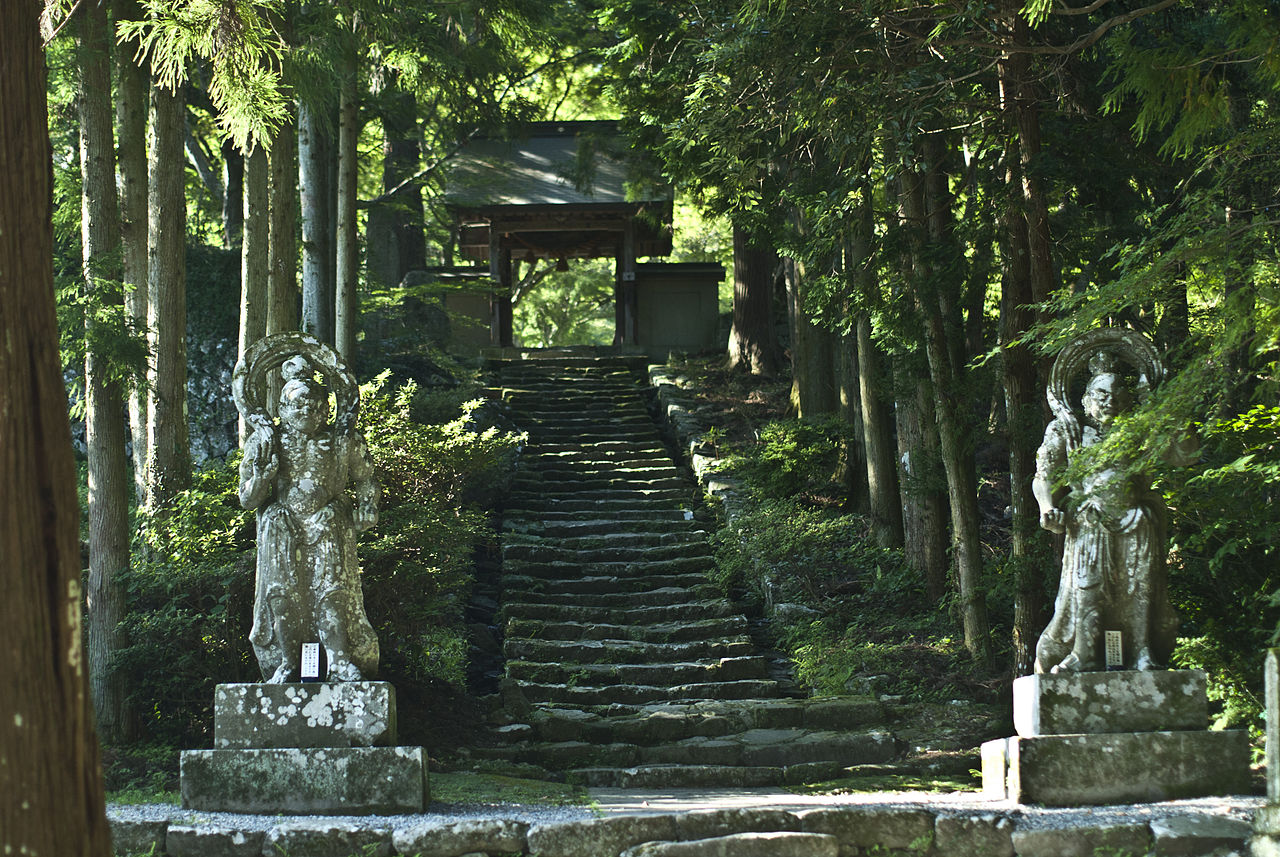
Futagoji, located in the center of the peninsula, is a central ancient temple of Rokugo Manzan, known for the Nio statues along its mossy approach and as a place of prayer for conceiving and raising children. Monjusenji is said to be the birthplace of the proverb Three people gathered make the wisdom of Monju, and it draws worshippers as a temple for academic success that grants wisdom. Both are cradled in the bosom of steep rocky mountains, and their grounds enveloped in deep greenery are full of a mysterious atmosphere.

Access & Basic Information
For access, Oita Airport, on the southeast of the peninsula, is convenient. The general approach is to use Usa Station or Kitsuki Station on the JR Nippo Main Line as a base and tour by rental car. Because the temples are scattered in the mountains and public transport is limited, traveling by car is reassuring. Each temple's hours and admission differ, and in the mountains you should also watch for icy roads in winter. The approach to the Kumano Magaibutsu is a steep stone staircase, so visit in shoes that are easy to walk in. Touring the peninsula while visiting ancient temples, cliff-carved Buddhas, and rural scenery makes for a heart-cleansing journey of prayer.
Practical Travel Notes
- Best season and time: Early summer, when the fresh greenery is dazzling, and autumn, when the foliage dyes the mountains, are ideal. Visiting during bright daytime hours is safer, and since the sun sets early in the mountains, act early.
- Time needed: About 30 minutes to an hour round trip to visit the Kumano Magaibutsu. Touring several, such as Futagoji and Monjusenji, makes a full-day circuit.
- Avoiding crowds: Apart from weekends in the foliage season it is relatively quiet, and weekdays allow a relaxed visit.
- Nearby real spots: Fuki-ji (with its National Treasure Amida hall), Tashibu-no-sho, and Bungo-Takada's Showa no Machi. These can be toured together with the temples of Rokugo Manzan.
- What to bring and note: There are poor footholds such as the Kumano Magaibutsu staircase, so wear shoes that are easy to walk in. Watch for icy mountain roads in winter.
A Word of Advice
Because the temples are scattered in the mountains and public transport is limited, touring by rental car is reassuring. The approach to the Kumano Magaibutsu is a steep stone staircase, so visit in shoes that are easy to walk in. Circling the peninsula together with Fuki-ji and Tashibu-no-sho lets you experience the syncretic Rokugo Manzan culture more deeply. Since the sun sets early in the mountains, enjoy your journey of prayer with a schedule that allows time to spare.
📚 Sources
For information on the temples of the Kunisaki Peninsula and the Rokugo Manzan tradition, the main references are the tourism guidance published by local governments and tourism associations such as Bungo-Takada City and Kunisaki City, and the guidance of each temple. The histories of the Kumano Magaibutsu (a national Important Cultural Property and historic site), Futago-ji, and Monjusen-ji can be traced through such public guidance and on-site explanations. Each temple's viewing hours and fees differ and may change, so please confirm the latest details through official sources before you visit. Cultural-property designations can also be checked in public records.
Visitor Checklist
- Estimated time: Visiting the Kumano Magaibutsu takes about 30 minutes to 1 hour round trip; touring several such as Futago-ji and Monjusen-ji makes a full-day loop.
- What to bring: The approach to the Kumano Magaibutsu has steep stone steps, so comfortable shoes are essential; also carry coins for each temple's fees, and in winter watch for icy mountain roads.
- Suggested route: After climbing the stone steps to worship at the Kumano Magaibutsu, tour Futago-ji and Monjusen-ji, then combine Fuki-ji, Tashibunosho, and Bungo-Takada's Showa no Machi noted in the article for a peninsula loop.
- Getting around: With temples scattered in the mountains and limited public transport, touring by rental car is reassuring; dusk comes early in the valleys, so act early.
Practical Information for Your Visit
- Kumano Magaibutsu cliff carvings (Bungotakada City official information): Admission is 500 yen for adults (general visitors and high school students) and 150 yen for elementary and junior high school students (for groups of 30 or more, 400 yen for adults and 120 yen for children). These prices have applied since April 1 of Reiwa 8 (2026).
- Visiting hours for the Kumano Magaibutsu: From April to October 8:30 a.m. to 5:00 p.m., and from November to March 8:30 a.m. to 4:30 p.m. The address is 2546-3 Tashibu Hirano, Bungotakada City, and there is parking for 10 cars.
- Fukiji Temple (Bungotakada City official information): Visiting hours 8:30 a.m. to 4:30 p.m., admission 500 yen for general visitors and high school students and 150 yen for elementary and junior high school students. The address is 2395 Tashibu Fuki, Bungotakada City. The Amida hall (Odo) is a National Treasure, and in wet weather you cannot go inside the Odo to view it.
- Futagoji Temple (Kunisaki City official information): Visiting hours 8:30 a.m. to 4:30 p.m., admission 300 yen. The address is 1548 Futago, Aki-machi, Kunisaki City.
- Monjusenji Temple (Kunisaki City official information): Visiting hours 9:00 a.m. to 4:30 p.m., admission free. The address is 2432 Daionji, Kunisaki-machi, Kunisaki City.
- Kunisaki Peninsula Minemichi Long Trail (Bungotakada City official information): About 135 km in total. It links the Kumano Magaibutsu in Bungotakada City with Futagoji Temple in Kunisaki City, with four courses numbered T-1 to T-4 on the Bungotakada side and six courses numbered K-1 to K-6 on the Kunisaki side.
- Trail conditions (Bungotakada City official information): Part of the T-2 course cannot be walked because of logging, and a temporary detour route has been set up (marked with yellow and yellow-green tape). The toilets use mountain water, so visitors are asked to make sure the lever has returned fully to its original position after use.
*The closing days of Futagoji and Monjusenji, the number of parking spaces at each temple (Futagoji and Monjusenji), and the latest conditions along the whole of the Minemichi Long Trail are not published officially. *The admission fee for the Kumano Magaibutsu is the amount revised on April 1 of Reiwa 8 (2026). (Sources: the official Bungotakada City tourism website, and the Kunisaki City official website)
📍 Location & Access


Share this article


✍️ About this article
This article is compiled by the Tabitabi JAPAN editorial team from official and primary sources, including facility and shrine/temple websites, tourism information published by municipalities and tourism associations, and cultural-property records released by national and local governments. Prices, opening hours and event dates may change, so please also check the official information of each facility or local government before you visit.