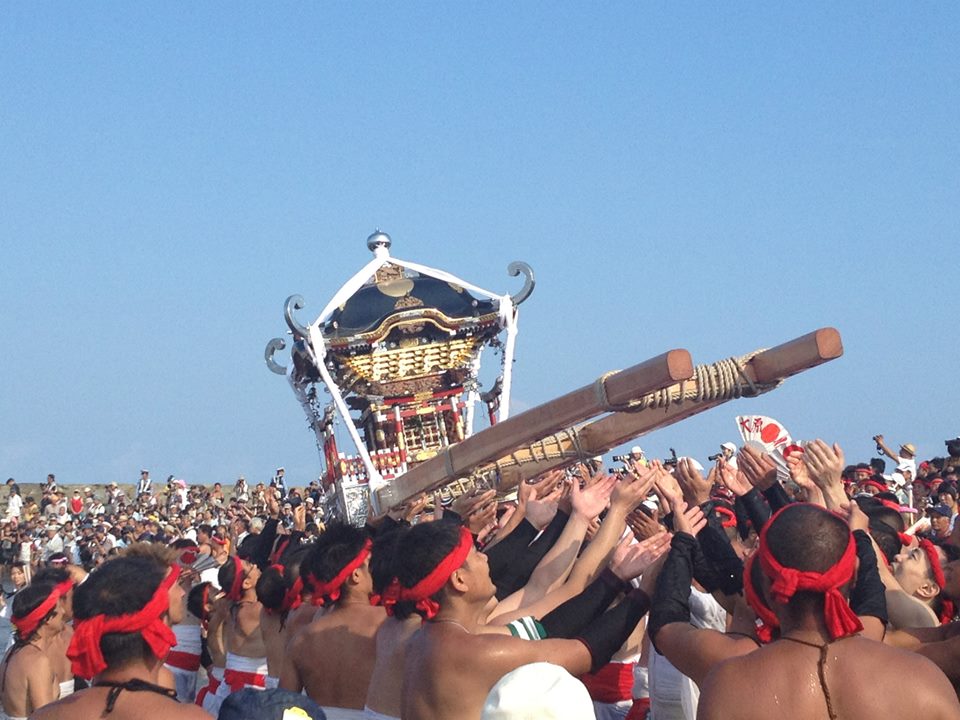
Ohara Hadaka Matsuri: Mikoshi Charging into the Sea
On 23 and 24 September every year, the Ohara district of Isumi City on the Pacific coast of Chiba Prefecture holds one of the most physical festivals in eastern Japan. On the first afternoon, more than a dozen portable shrines are carried straight off the sand and into the surf in a rite called shiofumi, offered for a good harvest and a good catch. After dark on both days, the same shrines move through the shopping street by lantern light and gather in a school playground for the farewell ceremony known as owakare-shiki. Sea and town, daylight and darkness, all belong to the same two days.
Shiofumi: Shrines Carried into the Surf
Early in the afternoon of the first day, the shrines of each neighbourhood are lined up on the sand at Ohara beach. Men wrapped in white cotton sashes duck under the carrying poles, the chanting builds, and then the whole line breaks into a run toward the water. Waist deep, then chest deep, they hoist the shrines overhead, jostle, and throw them upward again and again. Spray flies and salt water and sweat run off the bearers together. Plenty of Japanese festivals take a shrine into the sea, but very few send this many in at once, shoulder to shoulder.
Owakare-shiki: The Farewell by Lantern Light
Both days build toward the farewell ceremony at night. The shrines gather in front of the Kidoizumi sake brewery and move along the Ohara central shopping street to the singing of festival songs. A line of paper lanterns stretches down the darkened road while residents watch from their doorways, and the mood is entirely different from the afternoon: quieter, but no less intense. The shrines then enter the playground of Ohara Elementary School, circling the wide ground and pressing together over and over as though reluctant to part. When the drums finally stop, the bearers link shoulders and promise to meet again the following year.
A Rite from the Edo Period
The festival is understood to have been held since the Edo period. Votive tablets dedicated at Takiuchi Shrine, one dated 1864 and another from the Tenpo era, show that the customs of the festival and the organisation of the bearers were already established more than a century and a half ago. The dates have shifted over time. The festival once fell on 13 to 15 August; in 1873 it was moved to 23 to 25 September, and since 1913 it has settled into the present two days of 23 and 24 September. Behind all the noise lies a long, plain history of coastal families praying for fish and for rice.
Tips for Visiting
Shiofumi takes place on sand, so wear shoes or sandals you do not mind filling with grit, and protect cameras and phones from the spray. Late September sun on an open beach is still fierce, and there is almost no shade, so a hat and water matter more than you might expect. The evening ceremony is a different problem: the sea breeze turns cold once the light goes, and an extra layer is welcome. The shrines change direction suddenly and with real force, so families with small children and older visitors should stand a clear step back from the bearers' path.
Getting There
Ohara Station, served by the JR Sotobo Line and the Isumi Railway, is the gateway to the district. Note that the Isumi Railway has suspended all train services following a derailment (replacement buses are running; restoration is expected around autumn 2027), so plan to arrive on the JR Sotobo Line. The shopping street and the elementary school are within walking distance of the station, and so is the beach. On festival days traffic restrictions are put in place at various points to accommodate the shrine processions and rituals, and parking is limited to a small number of spaces including the Ohara branch of the Isumi city office. Visitors are asked to come by public transport.
Practical Information
- Dates: 23 and 24 September every year
- Venue: Ohara beach, the Ohara central shopping street, and the playground of Ohara Elementary School (Ohara, Isumi City, Chiba)
- Enquiries: Isumi City, Fisheries, Commerce and Tourism Division, 0470-62-1243
- Access: Ohara Station on the JR Sotobo Line (the Isumi Railway also serves this station, but the Isumi Railway has suspended all train services following a derailment (replacement buses are running; restoration is expected around autumn 2027))
- Parking: Limited, including the Ohara branch of the Isumi city office; public transport is recommended
- Traffic restrictions: Imposed at several points in step with the processions and rituals
- Official website: https://www.city.isumi.lg.jp/soshikikarasagasu/suisanshokoka/kankopromotionhan/2/2/786.html
* Dates, details and prices are subject to change. Please check the official website before you go.
(Sources: Isumi City official website)
📍 Location & Access


Share this article


✍️ About this article
This article is compiled by the Tabitabi JAPAN editorial team from official and primary sources, including facility and shrine/temple websites, tourism information published by municipalities and tourism associations, and cultural-property records released by national and local governments. Prices, opening hours and event dates may change, so please also check the official information of each facility or local government before you visit.