
Soka Senbei: A Famous Rice Cracker from the Edo Period
Soka senbei is a specialty representing Soka City, Saitama Prefecture, a traditional hard-baked rice cracker continuing from the Edo period. In Soka, which flourished as the second post town on the Nikko Highway, it is said that rice made into dumplings and dried as portable food for travelers became the prototype of senbei. The fragrant aroma of soy sauce and the crisp bite are born from a hand-baking craft unchanged to this day.
The History of a Rice Confection Nurtured by a Post Town
Soka was a land blessed with good-quality rice brought by the Ayase River and the soy sauce culture of the Kanto Plain. Flourishing as a hub of distribution to Edo, the wisdom of processing rice into preserved food developed, and this was refined into hard-baked senbei. From the Meiji era onward, with the opening of the railway it became known nationwide as a souvenir, and "Soka senbei" grew into a solid brand registered as a regional collective trademark.
The Hand-Baking Craft of Grilling Each One Over Charcoal
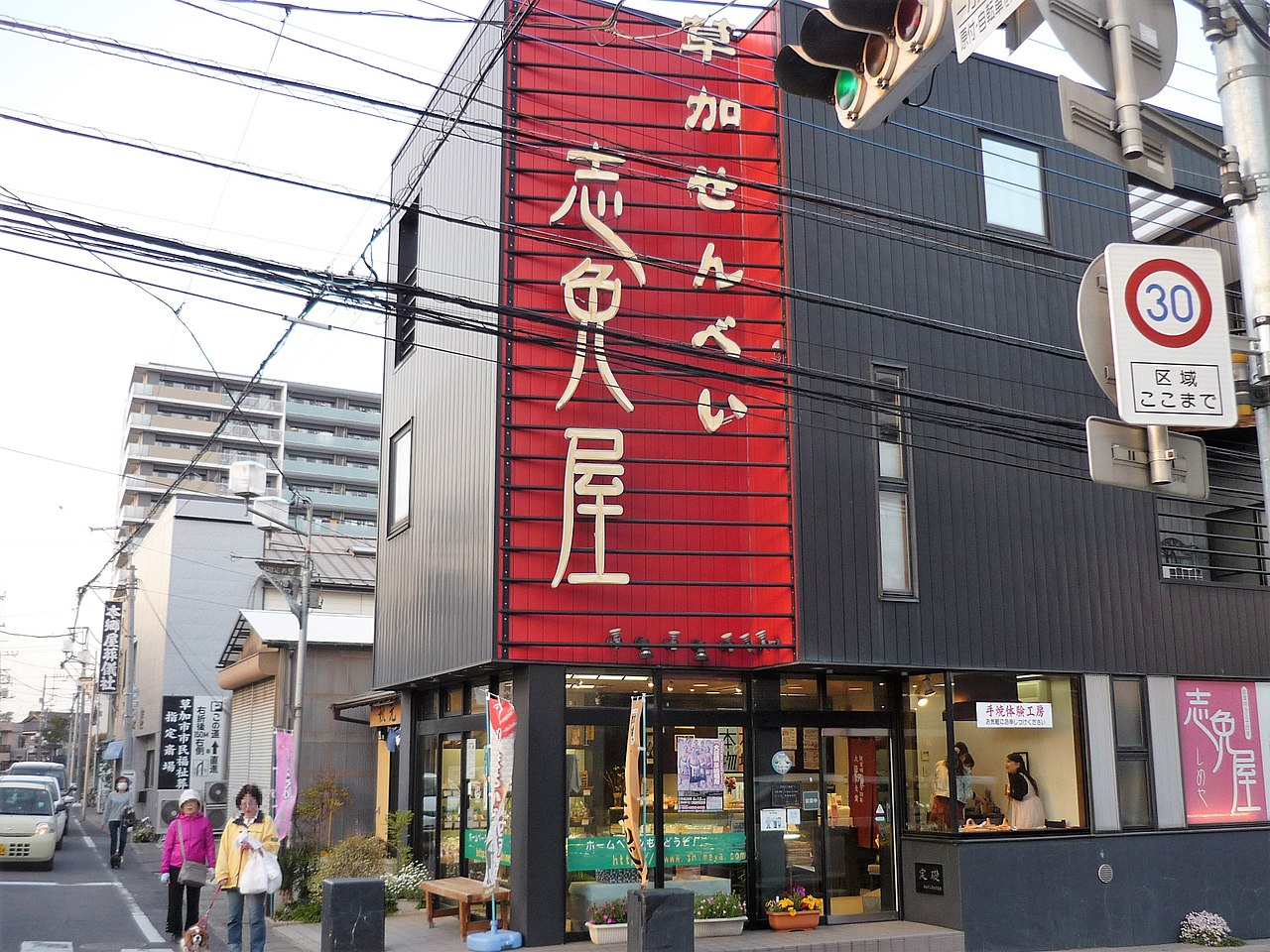
Traditional Soka senbei is baked by pressing each piece of dough over charcoal with a tool called an oshigawara. By turning them over and heating them evenly, the artisan completes flat, warp-free crackers that are hard to break. The moment when soy sauce is brushed generously onto the freshly baked crackers, the aroma rises, whetting the appetite just to watch. There are shops in the city where you can experience hand-baking, offering the pleasure of tasting a cracker you baked yourself.

Combined with a Stroll Through Soka Post Town
The Soka senbei shops line the old Nikko Highway, spreading within walking distance of Soka Station on the Tobu Skytree Line. Nearby is the beautiful pine avenue "Soka Matsubara," where you can stroll a promenade designated a national Place of Scenic Beauty as part of "The Landscapes of Oku no Hosomichi." The pine avenue, stretching about 1.5 kilometers, lines up more than 600 pines, and strolling while crossing the drum-shaped bridges "Hyakudai Bridge" and "Yatate Bridge," feeling the atmosphere of a post town, is recommended. Since each cracker shop has its own character in the strength and hardness of the soy sauce, you can also enjoy comparing tastes.
Access and Basic Information
For access, get off right at Soka Station on the Tobu Skytree Line from Kita-Senju in Tokyo. For Soka Matsubara, access from the neighboring Dokkyo Daigaku-mae (Soka Matsubara) Station is also convenient. Soka senbei can be bought year-round, but from autumn to winter with less humidity, the crisp texture of the crackers is preserved longer, making them suited to souvenirs. Since they keep well and are light, they are perfect as gifts, and the varieties are abundant, including coarse sugar, chili pepper, and nori-wrapped. Many long-established shops handle shipping, and ordering directly from the source lets you enjoy the fresh-baked aroma at home.
Practical Travel Notes
A standard strolling course is to walk along the old Nikko Highway from Soka Station, peeking into cracker shops, and extend your walk to Soka Matsubara. Walking the pine-avenue promenade and the two drum bridges leisurely takes about one to two hours round trip. At shops where you can experience hand-baking, you can taste a cracker you baked yourself on the spot, making it recommended for creating travel memories. To enjoy comparing tastes, buy a few crackers each at several shops and compare the differences in the strength and hardness of the soy sauce. A freshly baked cracker savored midway through your stroll is exceptional.
A Word of Advice
Hard-baked is the original charm of Soka senbei, but since hardness and seasoning have their own character depending on the shop, searching for your favorite cracker is one of the pleasures. Hand-baking experiences are popular, so if you wish to do one, inquiring with the shop in advance is reassuring. For souvenirs, taking advantage of their good keeping quality to assemble an assortment of various types is recommended. Combined with a town walk where the atmosphere of a post town remains, enjoy the flavor and history unique to Soka.
📚 Sources
This article is based on materials on the history of Soka senbei and its regional collective trademark, and tourism information for Soka City. It also draws on guidance for Soka Matsubara, designated a national place of scenic beauty as part of the Oku no Hosomichi scenery, the Hyakutai and Yatate bridges, and shops offering a hand-grilling experience. Each shop's open days and the hand-grilling reservations may change, so please confirm with official sources before you go.
Visitor Checklist
- Estimated time: About 1 to 2 hours round trip walking the Soka Matsubara pine avenue and its two arched bridges.
- How to get around: The classic route walks from Soka Station along the old Nikko Kaido, browsing senbei shops out to Soka Matsubara.
- Access: Get off at Soka Station on the Tobu Skytree Line; the neighboring Dokkyo Daigaku-mae (Soka Matsubara) Station is also handy for the pine avenue.
- Tasting tip: Buy a few pieces from several shops to compare the strength of the soy and the crispness.
- Experience prep: Hand-grilling is popular, so inquire with the shop in advance if you would like to try.
- Souvenirs: Take advantage of the long shelf life and put together an assortment of varieties.
Practical Information for Your Visit
- The definition of "Soka senbei": Soka senbei was registered as a regional collective trademark in June 2007 (Heisei 19). The standards at the time of certification were that the crackers be made in "Soka, Yashio, Kawaguchi, Koshigaya or Hatogaya," that the raw material be "good-quality non-glutinous rice harvested in Kanto and its neighboring prefectures," and that the method be one in which "a craftsman with at least 10 years of experience supervises production" and the crackers are "baked in molds with oshigawara (pressing tiles), or hard-baked by a method incorporating the oshigawara technique" (Soka City official site / updated August 7, 2025).
- Hand-grilling experience 1: Soka Senbei Shimeya Main Shop: 1-11-1 Shinmei / 9:00-21:00 (hand-grilling experience 9:00-18:00) / closed on Fridays / 100 yen per cracker / no reservation required (for parties of 5 or more, booking ahead is safer) / 0120-211-721
- Hand-grilling experience 2: Yamaka Senbei Honpo "Soka Senbei no Niwa": 790-2 Kinmeicho / 10:00-18:00 / open every day / 825 yen for 2 crackers per person / no reservation required / 048-942-1000
- Hand-grilling experience 3: Ikedaya: 4-1-40 Yoshicho / 9:00-19:00 / closed on January 1 and 2 / 600 yen for 3 crackers per person (brush included) / reservation required (by two days in advance) / 048-922-2061
- Hand-grilling experience 4: Soka Senbei Maruso Ippuku Main Shop and Factory: 2-16-18 Aoyagi / 9:00-18:00 (hand-grilling experience from 10:00 and from 13:30) / closed on January 1 and 2 (factory tours and hand-grilling experiences are not held on Sundays, public holidays or during busy periods) / 800 yen for 1 cracker per person / reservation required / 048-936-6301
- Hand-grilling experience 5: Soka City Traditional Industry Exhibition Room "Parisse": 1-1-5 Matsue, Soka City (inside the Soka City Culture Hall) / closed on the first Wednesday of each month, over the New Year period and on other days / 500 yen for 2 crackers per person / by reservation / 048-931-1970
- Soka Matsubara: Designated in March 2014 (Heisei 26) as a national Place of Scenic Beauty, "Scenic Sites of Oku no Hosomichi: Soka Matsubara." 634 pine trees line the avenue of about 1.5 kilometers, which is spanned by the drum-shaped Hyakutai Bridge and Yatate Bridge.
- Updates to the experience information: The list of hand-grilling experiences was updated on the Soka City official website on April 21, 2026.
* Please check the opening hours of "Parisse" and the time required for the hand-grilling experience at each shop in the official information of each facility and shop before your visit. (Sources: Soka City official website, "Soka Senbei Hand-Grilling Experience" (updated April 21, 2026), "The History and Present of Soka Senbei" (updated August 7, 2025), and "Scenic Sites of Oku no Hosomichi: Soka Matsubara")
📍 Location & Access


Share this article


✍️ About this article
This article is compiled by the Tabitabi JAPAN editorial team from official and primary sources, including facility and shrine/temple websites, tourism information published by municipalities and tourism associations, and cultural-property records released by national and local governments. Prices, opening hours and event dates may change, so please also check the official information of each facility or local government before you visit.